


A Robbery Gone Perfectly Wrong - an Editorial Review of "Love and Money"
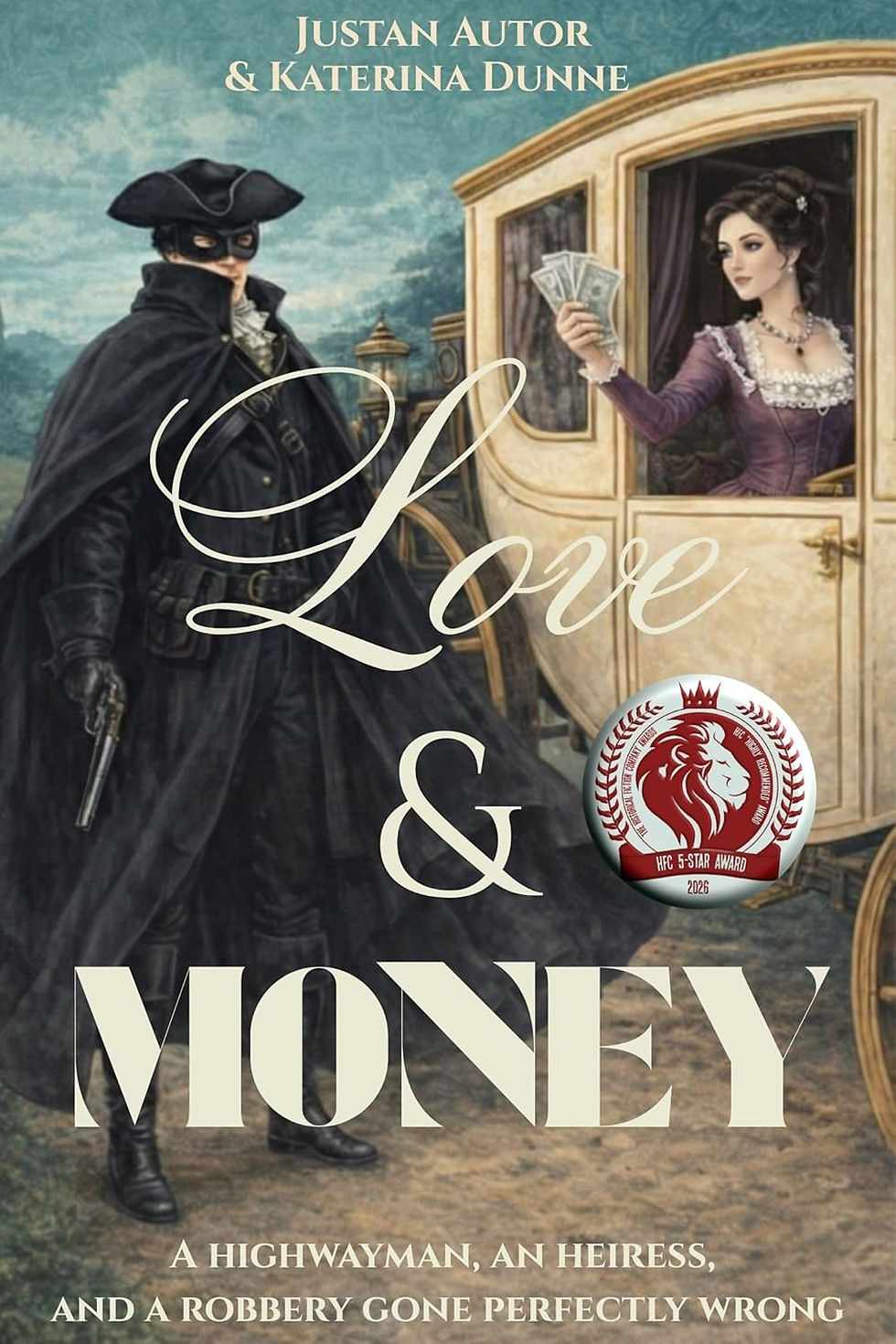
Book Blurb:
'Tis a truth universally acknowledged that a gentleman in possession of a good fortune must be in want of a wife. However, our Hero is in possession of no fortune whatsoever. And thus, we have a History to relate...
1865. Somerset.
Love and Money, those twin pillars upon which the precarious edifice of Mortal Existence rests, have rarely been more at odds. For Mr Francis Sheringham — a libertine whose charm is far more substantial than his purse — desperate times call for desperate measures. When the vengeful Lord Grant cheats his father out of their ancestral home, our Hero finds himself forced into an audacious new career: Highway Robbery.
Yet, it must be said, he is no common thief. As the most courteous Rogue on the King's Highway, Francis leaves his female victims more captivated than terrified. And lo! His path collides with Miss Vanessa Lockwood — a fiercely independent Heiress of Uncommon Spirit trapped by the schemes of the very man who ruined Francis.
The Reader is herein invited to witness a Rollicking Burlesque of mistaken identities, disastrous Fancy-Dress Balls, calamitous Kidnappings, and farcical Duels. Amidst the Chaos, Francis must reclaim his Fortune, outwit his Enemies, and convince the one woman immune to his practiced wiles that his Heart is truer than his Aim. In a world where Passion and Property are at war, the ultimate prize is a Love that Money simply cannot buy.
‘Tis Picaresque. ‘Tis Preposterous. ‘Tis Love & Money.
Perfect for Adorers of the Picaresque & Pastiche: This novel is a stylistic homage to the literature of the 18th & 19th century, written for those who crave an immersive, archaic voice akin to the Susanna Clarke mode (think Jonathan Strange & Mr Norrell, albeit with felons in place of fairies), and the roguish, rambling energy of Henry Fielding (Tom Jones). Moreover, if you delight in the sharp social satire of Jane Austen, but have wondered what such courtships might have been when coupled with a botched kidnapping and a highwayman's pistol, then Love & Money might just be your next great adventure!
⭐ ⭐ ⭐ ⭐ ⭐ “A sparkling, savvy & thoroughly enjoyable read.” The Historical Fiction Company
Tropes & Themes: The Gentleman Highwayman: A charming rogue whose manners are as polished as his pistols. Enemies to Lovers: A battle of wits between a practiced flirt and the one woman who sees right through him. Mistaken Identity: A comedy of errors featuring masks, disguises, and disastrous fancy-dress balls. Love vs. Money: The eternal struggle between the heart’s desire and the purse’s strings. Aristocrat in Decline: A steep fall from grace where a nobleman must turn to crime to pay the bills. Comedy of Manners: A satirical poke at the pretensions and hypocrisy of Victorian high society. The Spirited Heiress: A heroine with a fortune who refuses to be a pawn in men's games. The Scheming Villain: A classic antagonist governed by avarice, spite, and bad intentions.
Book Buy Link: https://geni.us/LUxf8W
Author Bio:

Justan Autor came late to the wicked joy of novels, having first tried his hand at most of the civilised arts: he painted pictures, trimmed hedgerows into obedience, stitched respectable garments, and wooed a pianoforte into confessing melodies. Only thereafter did he discover that narrative mischief suited him best.
A devotee of the 18th and 19th‑century masters, he writes in a classical key with a modern tempo — history that crackles, characters with inconvenient desires, and a burlesque glint when daggers flash. His first novel ushers readers into 1790s Switzerland: mountains, intrigue, and a hero who frequently collides with his own better judgement.
If you fancy Dumas for the dash, Fielding for the grin, Austen for the bite, and Dickens for the sweep — served with present‑day verve — do make his acquaintance.

Katerina Dunne is the pen-name of Katerina Vavoulidou. Originally from Athens, Greece, Katerina lived in Ireland between 1999 and 2025 and has since settled in sunny Cyprus. She has a degree in English Language and Literature from the University of Athens, an MA in Film Studies from University College Dublin and an MPhil in Medieval History from Trinity College Dublin. While she used to write short stories for family and friends in her teenage years, she only took up writing seriously in 2016-17, when she started work on her first novel.
Katerina’s day job is in financial services, but in her free time she enjoys reading historical fiction and watching historically-themed movies and TV series. She is passionate about history, especially medieval history, and her main area of interest is 13th to 15th century Hungary. Although the main characters of her stories are fictional, Katerina uses real events and personalities as part of her narrative in order to bring to life the fascinating history of the medieval Kingdom of Hungary, a location and time period not so well-known to English-speaking readers.
Editorial Review:
Title: Love and Money
Author: Justan Autor, Katerina Dunne
In "Love and Money," Authors Justan Autor and Katerina Dunne deliver a witty and intricately woven plot set in the 1860s England. It comes alive through sparkling dialogue, sharp social satire and a narrative that balances romance, revenge and rollicking farce. Through the entwined fates of the disgraced libertine Francis Sheringham- a man who trades his honor for money, and the formidable heiress Vanessa Lockwood- a young woman caught in between her personal desire for autonomy and her familial duty to preserve her father's legacy, this book explores the precarious dance between affection and avarice, which come out as the two pillars that define their world.
"Earthwards plummeted Francis with a most unheroic yelp. His descent, alas, terminated not upon the soft turf, but squarely amidst the barbed embrace of what proved to be Her Ladyship’s pride and joy — her much-trumpeted champion roses. From the prickly darkness below, arose a sermon of profanity wholly unfit for repetition in polite society. His once-fine coat got comprehensively snagged, his hide perforated in more places than a colander, whilst his self-respect sustained the direst casualties of all."
This opening calamity is a masterful introduction to the novel's central themes as well as its hero's flawed nature. Francis's undignified plunge from a lover's window into a rosebush is the perfect metaphor for the events that have tragically occurred in his life, causing his sudden descent from rakish glamour into a painful, prickly reality. The language here is richly satirical, particularly when describing the "barbed embrace" of nature that greets him. Here, we see roses, widely known as symbols of cultivated beauty and passion, suddenly become instruments of humiliation that puncture not just his skin but also his carefully maintained facade of cavalier invisibility.
“Your civility, sirrah, is positively overwhelming!” retorted Mr Russell with tones that left precious little doubt as to his sarcasm; “it quite makes up for the loss of one’s property!”... “Madam,” responded Francis, receiving the cascade of jewels with another bow, “allow me to venture that a lady of your manifest charms and — if I may be so bold — your striking natural complexion, stands in no need whatsoever of such vitreous trinkets to advertise her inherent radiance to the world.”
Here, the novel's brilliantly satirizes the inextricable link between social manners and moral compromise. Francis applies the polished etiquette of the ballroom to his victims, disarming them with his genteel, charming disclosure. This scene is sharp with identity and moral questions particularly from Francis' success which comes when he performs gentility during criminal acts. The exchange lays bare one major conclusion- that in a world where everything including love, security, status has become transactional, the line between a genuine compliment and manipulation has equally become dangerously blurred.
“One moment, if you please, sir!” Vanessa turned her full attention back to our hero. “Your mask, sir.” Her voice was low but firm. “Remove it. Now.” “I... I cannot!” groaned he. The very idea of revealing his identity in such circumstances — to her of all people! — filled him with so profound a sense of dread as to almost outweigh that of Lord G and the Law’s imminent arrival... Torn in that agonising moment between the Scylla of the law and the Charybdis of social ruin, Francis made his choice..."
This mask moment is a real turning point that delivers raw, charged and intimate stakes. The demand to remove it feels like a metaphorical stripping of Francis' defenses- where he has to abandon the role he has been hiding behind. It also emerges as a power shift moment between him and Vanessa, the latter of whom, from a position of enforced social powerlessness seems to finally seize narrative control. This scene transforms their dynamic into a complex negotiation between two individuals, who feel like they are similarly navigating a system that has been designed to commodify them.
The characters in this book emerge as intricately woven, serving the novel's sharp themes which include love versus money, honor versus survival and performance versus authenticity. Surrounding them are well-drawn supporting characters who feel purposeful, each embodying a different facet of the central critique. The pacing helps too. It does not drag but instead, moves fluidly between scenes of high tension and brilliant satire without losing momentum.
"Love and Money" ultimately works as both entertainment and critique. It wields its wit with precision like a surgeon's scalpel, exposing a society obsessed with lineage and wealth as the measure for legitimacy rather than character. In doing so, it makes a simple but powerful point to its readers that the most perilous roads are not those haunted by highwaymen, rather, they are the familiar paths of social expectation, inheritance and obligation. A sparkling, savvy and thoroughly enjoyable read.
5 stars from The Historical Fiction Company and the “Highly Recommended” award of excellence
Award:

To have your historical novel editorially reviewed and/or enter the HFC Book of the Year contest, please visit www.thehistoricalfictioncompany.com/book-awards/award-submission


Comments