


Fleeing a Life of Mistakes and Regret - an Editorial Review of "A Good Name"
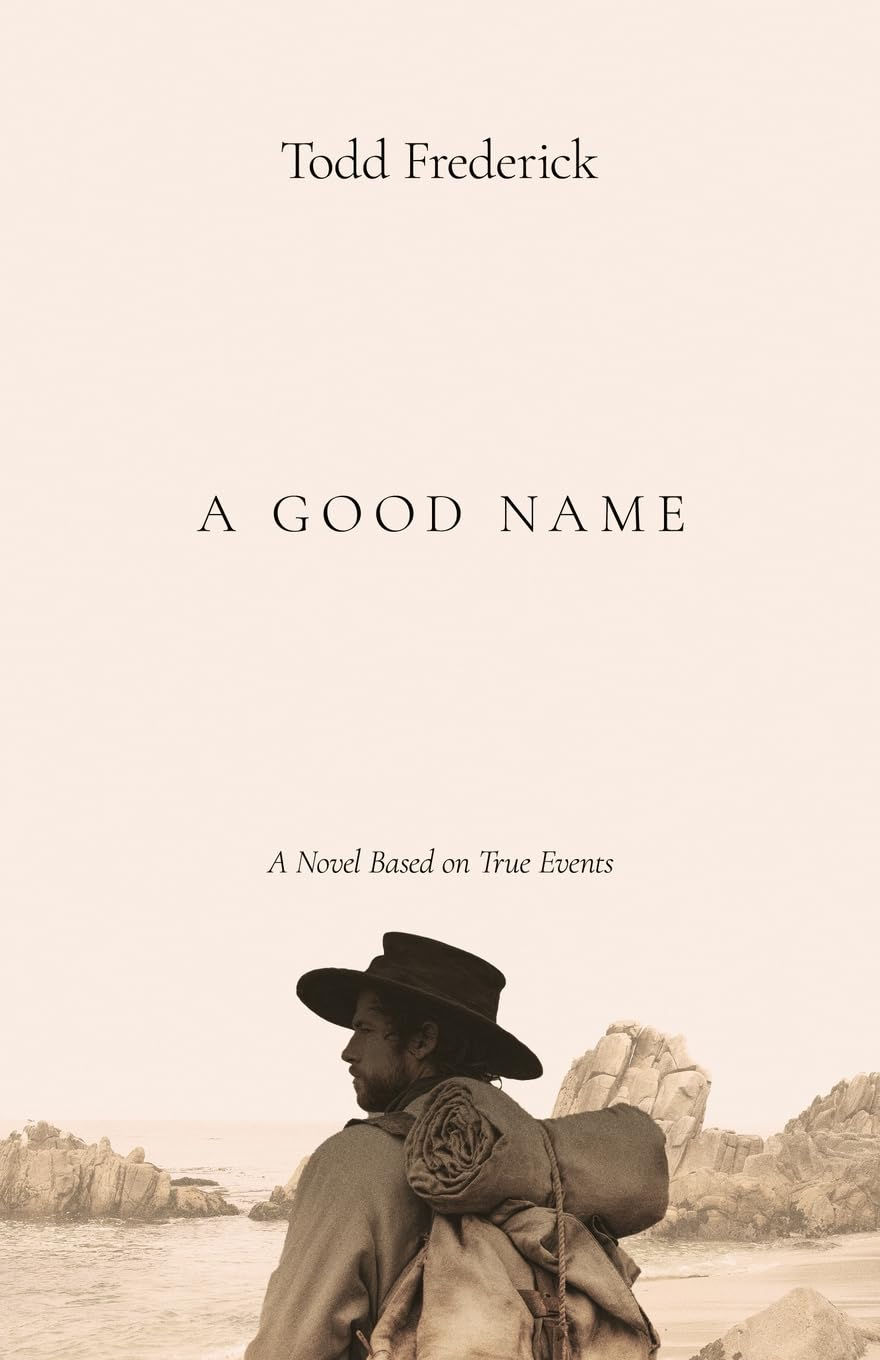
Book Blurb:
In 1841, Talbot Green arrives in Mexican California a man with a hidden past and a future yet to be claimed. Fleeing a life of mistakes and regret, he reinvents himself as a shrewd businessman in Monterey, navigating the quickly changing political, military, and economic times.
Through daring trade ventures, high-stakes negotiations, and a partnership and friendship with the influential Thomas Oliver Larkin, Green rises from outsider to central figure in California’s transformation from Mexican territory to U.S. statehood. Along the way, he discovers the power of loyalty, generosity, and love—even as the shadows of his former identity threaten to destroy everything he has built.
A Good Name is a sweeping historical drama of ambition, reinvention, and the costs of the past—a vivid portrait of a man learning that while a name can be borrowed, a truly good name must be earned.
Book Buy Link: https://geni.us/kvxO
Editorial Review:
Title: A Good Name
Author: Todd Frederick
Rating: 4.4
“You are foreigners without passports or papers, so you’ll have to be careful. The presidios are in Monterey to the south and at the mouth of San Francisco Bay west of us. The Mexican troops move between them regularly, so you’ll do best to avoid the coast. There’s plenty of open country in the valley here, but you’ll have to be careful where you settle. If you come across other Europeans or Americans, you’ll likely be welcomed, but we’re few. The Californios in the northern part of the department here don’t care for Mexican rule much, so some of them will be friendly, but there are loyalists who’ll see you as squatters and will hand you over to the Mexican army if they don’t just shoot you outright. You won’t be able to tell the difference between them until they’re shaking your hand or shooting you.”
This entry point into Todd Frederick’s “A Good Name,” a novel based on true events, reveals to the reader the landscape of California, a destination that a group of sixteen hikers arrives at, specifically Rancho Los Méganos. Among them is Talbot Green, a man on a quest for redemption and to make a good name for himself through hard work, new relationships and good deeds. California is not a welcome frontier rather, it is a dangerous and an uncertain territory caught between Mexican rule and California’s rebellion. The reader immediately feels the danger and tension, even as the question arises on whether Green will be safe in a land that can as easily take away the good name that he seeks to establish. The reader is conditioned for a narrative where nothing is guaranteed, and where dramatic betrayal even by those one trusts looms as an ever-present threat.
“Green listened well and learned well. He was quick to master the business and the trading, but was frustrated by the language. He
Convinced Finney to let him try some negotiations, speaking English to the rancheros. Some of the Mexicans and Californios spoke English well enough, but they wouldn’t admit it to an American. They would do business only in Spanish, and Green tried not to let his frustration show. He listened carefully to the words that Finney used, and he practiced them in his head, but when the traders spoke at full speed, Green would get lost and discouraged.”
The reader understands that Green’s struggle with English is the ultimate test of his ability to belong, even as he tries to build a new life. The gap between knowing the words and understanding the language is vast, and accurately mirrors the gap between wanting redemption and actually achieving it. He is a man who the reader has met as composed and largely calm but by being flustered here, the moment humanizes him reminding the reader that he is still an outsider who is vulnerable and who is trying to earn a place- a struggle that many of us are familiar with.
“It’s from Commodore Sloat,” Larkin said. “A group of Americans has taken over a small Mexican garrison at Sonoma. They’ve declared California an independent republic and have hoisted their own crude flag to represent the nation. Fremont has seized the opportunity and joined the group. Lieutenant Gillespie is with Fremont, and they have reinforced the Bear Flag garrison.” Green stared at Larkin. “Are there many dead?” “The Mexicans aren’t fighting, but the fool rebels have taken John
Sutter and Mariano Vallejo captive. If Fremont harms Mariano, I’ll hang him myself.”
“Is this war?”
This novel is grounded in real history like this moment which depicts the Bear Flag Revolt. Larkin, a man who values diplomacy over reckless revolution and a man who has been the doorway to the new life Green wants desperately to build, suggests that the Revolt rebels are reckless. The moment places green between a rock and hard place where he cannot support the American rebels without betraying the life he has built in California. The reader knows that he can also not support the Mexican loyalists without denying his own heritage. His question “is this war” is the central uncertainty, a deep sense of worry about which side he will eventually settle on, and what that will do to his loyalty to Larkin. He is trapped and the reader feels his anxiety.
This book’s characters feel real and multi-dimensional. They change and grow over the course of the story, their motivations are understandable even when they make mistakes, and they are easy to care about. They include Green, a deeply flawed and ambitious protagonist whose past haunts him and whose desire to escape it feels understandable, Sarah, a strong resilient and independent woman who has had her own share of tears, and Larkin, a central figure who is successful, loyal and principled, and a man who unexpectedly forgives a wrong that would be easy to resent. It explores the powerful theme of earning a good name by asking hard questions, through a well-structured plot that has rising action. It also uses foreshadowing and irony to create tension and emotional depth such as the protagonist’s evasion of his past which hints at a secret.
Todd Frederick’s “A Good Name” is undoubtedly deeply researched, its setting is immersive and authentic and it beautifully captures the divided loyalties of the time. It will be a deeply rewarding read for readers who enjoy learning history through storytelling, those interested in California’s transition from Mexican territory to American statehood, those drawn to stories about identity and belonging, as well as those who enjoy character-driven stories.
To have your historical novel editorially reviewed and/or enter the HFC Book of the Year contest, please visit www.thehistoricalfictioncompany.com/book-awards/award-submission


Comments